
A Simple Guide to Italy's Court System

If you are pursuing Italian citizenship by descent, you are not just dealing with paperwork. You are stepping into a legal system that has spent decades defining what citizenship actually means.
At its core, this system is not always straightforward. It involves a balance between administrative rules and legal interpretation, and between courts that do not always agree.
Understanding how these pieces fit together is the key to understanding your claim to jure sanguinis.
Courts vs Consulates: Where Everything Begins
Italian consulates are administrative offices. They apply the law exactly as written. They do not interpret it, and they cannot correct it.
If your application does not meet the strict criteria, the consulate must deny it.
Courts are fundamentally different. They:
- interpret the law
- resolve contradictions
- apply constitutional principles
- correct outdated or discriminatory rules
This is why complex citizenship cases often end up in court. Consulates are bound by procedure. Courts are the only place where legal reasoning and constitutional principles can reshape how citizenship law is applied, especially when the written law does not fully reflect modern constitutional values.
The Basic Structure of the Italian Court System
Italy’s civil court system operates in four main layers:
1. Lower Courts (Tribunali Ordinari)
There are 26 main court districts that handle citizenship cases. The court that you use depends on which court has jurisdiction over the comune where your Italian ancestor was born.
What they do:
- first instance courts for citizenship recognition
- examine evidence such as birth, marriage, and naturalization records
- apply existing law to individual cases
How they function:
- each case is decided by a single judge or panel
- judges have significant interpretive freedom
- decisions are not binding on other courts
This is where divergence begins. Two judges can look at nearly identical cases and reach different conclusions, especially in evolving areas of law.
2. Court of Appeals (Corte d’Appello)
If a lower court decision is challenged, the case moves to the Court of Appeals.
What they do:
- review both facts and legal reasoning of lower court decisions
- reassess how the law was applied
Authority:
- stronger than trial courts, but still not final
- influential, but not binding nationwide
Appeals courts play an important role in shaping how laws are applied more broadly. They often refine the reasoning used by lower courts and may correct errors in interpretation.
However, different Courts of Appeal in different regions can still reach different conclusions. This means inconsistencies can continue to exist across the country.
3. Court of Cassation (Corte di Cassazione)
The Court of Cassation is Italy’s highest court for civil and criminal law. It is often compared to a supreme court, but its role is more specific.
It does not retry cases or reweigh evidence. Instead, it answers one key question:
Was the law applied correctly?
What it does:
- ensures consistent interpretation of the law
- reviews legal errors only
- issues authoritative legal principles that guide lower courts
If lower courts disagree, or start applying the law in inconsistent ways, the Court of Cassation steps in to restore coherence.
This is why it plays such a central role in citizenship law. Major developments like 1948 and involuntary naturalization cases were not created through legislation. Instead, the Court of Cassation ultimately made the rules clear and consistent by resolving disagreements and setting a direction that other courts could follow.
Inside the Court of Cassation
What makes the Cassation unique, and often misunderstood, is that it is not a single unified decision maker. It is divided into multiple sections, each with its own specialization.
Civil Sections (Sezioni Civili)
These sections handle different areas of civil law. For citizenship purposes, the most important is:
- First Civil Section (Prima Sezione Civile)
This is the section that most often handles citizenship cases. It deals with issues involving personal status, civil rights, and family law.
Different panels, even within the same section, can:
- interpret the law differently
- emphasize different legal principles
- reach different conclusions
This explains why disagreements can exist even at the highest level of the system. The law is not applied mechanically. It is interpreted by judges, and that interpretation can vary until a unifying principle emerges.
The Sezioni Unite (United Sections)
Within the Court of Cassation, there is a special formation called the Sezioni Unite, or United Sections, which functions as a unifying authority.
What they do:
- resolve conflicts between different Cassation rulings
- intervene when legal interpretation becomes unstable or inconsistent
- issue decisions intended to unify the entire legal system
They are called upon when there is a serious need to bring clarity to the law. When they speak, their rulings carry exceptional weight and are expected to guide all lower courts going forward.
Why the Sezioni Unite Matter Right Now
Today, Italian citizenship law is in a period of tension.
- The Court of Cassation continues to describe citizenship as:
- a right that exists from birth
- permanent and imprescriptible
- The Constitutional Court has allowed a framework where citizenship can be:
- conditional
- dependent on formal recognition
These ideas do not perfectly align. One treats citizenship as an inherent status. The other allows space for it to be limited by legislation and administrative structure. Until the Sezioni Unite issue a unifying decision, lower courts will continue to operate in a state of partial uncertainty, and outcomes may vary depending on how individual judges interpret this tension.
Independence and Limits of the Court of Cassation
The Court of Cassation has very high authority, but not absolute authority.
It controls:
- interpretation of ordinary law
- consistency across courts
It does not control:
- the constitutionality of laws, which belongs to the Constitutional Court
This creates an important dynamic where:
- the Court of Cassation can define what the law means
- the Constitutional Court can decide whether that law is valid in the first place
Why This Matters for You
For citizenship applicants, the most important court historically has been the Court of Cassation.
It has:
- opened the door to 1948 cases
- protected those affected by involuntary naturalization
- reinforced that citizenship exists before recognition
Its 2026 reaffirmation that citizenship is:
- an absolute subjective right
- existing from birth
- permanent and imprescriptible
continues a decades-long legal philosophy centered on individual rights, and provides a powerful legal foundation for those pursuing citizenship recognition today.
Every citizenship case is different. The strength of your claim depends on your lineage, timing, and how the law applies to your specific situation. If you’re unsure whether your case should go through a consulate or the courts, the best next step is to schedule a free consultation with someone who understands how these rules are actually applied in practice.
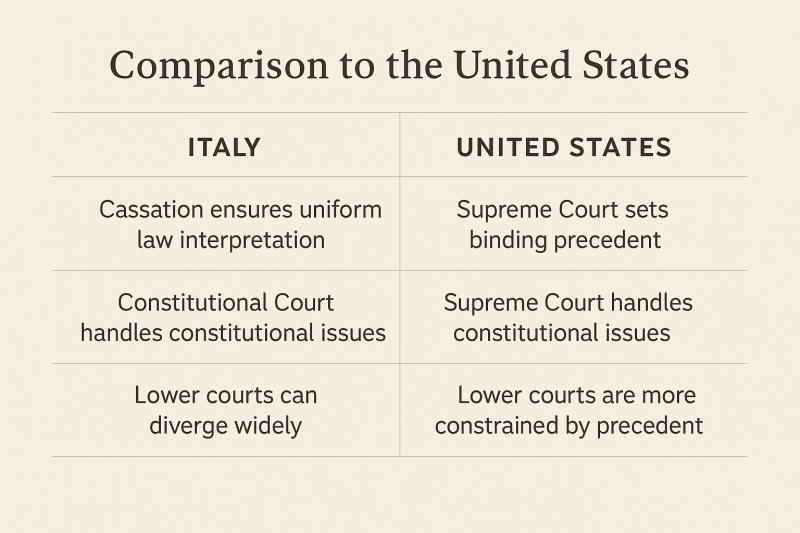
4. Constitutional Court (Corte Costituzionale)
This court is separate from the Court of Cassation and plays a different, specialized role within the legal system.
Unlike other courts, it does not decide individual cases in the traditional sense. Instead, it focuses on whether the laws themselves are valid.
What it does:
• decides whether laws comply with the Italian Constitution
• can uphold, strike down, or reshape legislation
In practice, the Constitutional Court is the final authority on whether a law is legally permissible at all.
Composition:
• 15 judges appointed by political and judicial institutions
• designed to balance legal expertise and state interests
This mixed composition is intentional. It brings together different perspectives, including judicial experience and institutional considerations, rather than operating purely as a technical court.
How it approaches cases:
The Constitutional Court does not look at issues in isolation. Instead, it balances multiple competing factors:
• individual rights
• legislative intent
• public interest
• administrative sustainability
This broader balancing approach is what distinguishes it from courts like the Court of Cassation, which focus more narrowly on applying the law.
This often leads the Constitutional Court to focus on overall system stability, not just the outcome of individual cases. As a result, its decisions can reflect not only legal principles, but also practical concerns about how the system functions as a whole.
How the System Works Together
The Italian court system works as a layered process, with each level playing a different role.
- lower courts apply and interpret laws independently
- appeals courts refine interpretations
- court of Cassation promotes consistency across the system
- Constitutional Court decides whether laws themselves are valid
However, they do not always agree, especially in high-stakes areas like citizenship. This creates a dynamic system where conflict is normal and often necessary for change.
The Historical Pattern: Courts Drive Change
To understand today’s legal battles, it’s important to understand how citizenship law evolved. The modern framework was not built all at once. It developed through decades of litigation.
Two major examples:
- 1948 cases involving female ancestors
- involuntary naturalization cases involving women who automatically lost Italian citizenship through marriage
The 1948 Rule: A 60-Year Evolution
Under pre‑1948 law:
- women could not pass down citizenship to their children
- only men transmitted Italian nationality
Even after the Constitution introduced equality in 1948, this rule remained in practice because:
- the Constitution was not applied retroactively
- consulates continued denying these cases
From the 1970s onward, the Constitutional Court recognized gender equality in principle but did not fully fix citizenship in practice.
Beginning in the 1990s, applicants turned to ordinary civil courts and these lower courts began applying constitutional equality directly, often reaching different results depending on the judge.
In the early 2000s, the Court of Cassation began issuing decisions that reframed the issue. The critical turning point came with Judgment No. 4466 in 2009, which confirmed that:
- constitutional equality must prevail in citizenship transmission
- descendants through female lines must be recognized
Involuntary Naturalization by Marriage
Before the U.S. Cable Act of 1922, many women automatically acquired their husband’s citizenship.
This caused:
- involuntary loss of Italian citizenship
- loss without consent
Courts eventually recognized that citizenship could not be lost in these situations without voluntary intent.
Through decisions including Constitutional Court No. 87 of 1975 and Cassation rulings culminating in 2009:
- women who acquired foreign citizenship automatically were treated as having retained Italian citizenship, since there was no voluntary renunciation
It took roughly 60 years for these rights to become widely accepted. The 1948 and involuntary citizenship rules still formally exist in administrative practice, but courts now routinely recognize these claims through judicial proceedings. This allowed citizenship to continue passing through these lines, restoring rights that had effectively been lost under older legal interpretations.
The Pattern Is Clear
These major changes all followed the same path:
- rigid administrative rules
- constitutional tension
- conflicting court decisions
- Cassation intervention
- eventual mainstream acceptance
Legal change came through the courts, not legislation.
Defining Citizenship
The Constitutional Court (April 30, 2026)
In Judgment No. 63/2026, the Constitutional Court upheld restrictions introduced by Law 74/2025.
It described a framework in which:
- citizenship by descent can be treated as a “precarious” or “virtual” right
- it becomes fully effective only when recognized
- the legislature can limit or reshape it retroactively
The Court of Cassation (May 12, 2026)
In Decision No. 13818/2026, the Cassation took a very different stance:
It reaffirmed, in explicit terms, that citizenship is:
- an absolute subjective right
- existing from birth
- permanent and imprescriptible
While the courts were not in direct conflict during the 1948 cases, a similar pattern is visible. The Constitutional Court established principles of equality but did not fully resolve how they applied to citizenship. Lower courts began applying those principles more broadly, and over time the Court of Cassation stepped in to make the rules clear and consistent.
Today, we are seeing a similar process unfold. The law has shifted, the Constitutional Court has set a framework, and once again the lower courts and the Court of Cassation are playing a central role in determining how citizenship rights are ultimately applied in practice.
Real-World Example: Courts Pushing Back
Recent lower court decisions, including rulings in Naples (May 14, 2026) and Bologna (April 17, 2026), show how judges are applying Cassation principles:
- applicants blocked by consular delays were still allowed to claim citizenship
- even post-2025 filings were accepted where intent to apply was clearly demonstrated
These decisions reflect growing resistance to strict administrative limitations and show that courts continue to act as a safeguard when the system prevents recognition, whether due to administrative barriers, missed procedural deadlines despite clear intent, or because certain cases, such as 1948 claims, were never accessible through administrative channels in the first place.
What Happens Next
Resolution will likely come from:
- continued lower court decisions
- different judges applying different reasoning
- intervention by the Sezioni Unite of the Court of Cassation
- potential future constitutional review
This process may take time, just as it did in previous phases of citizenship law development.
Final Takeaways
Italian citizenship law has never been static. It has always evolved through tension between courts, principles, and practice.
The most important rights were not granted all at once. They were built over decades through the work of judges interpreting the law case-by-case.
Today’s conflict is not new. It follows a pattern that has defined Italian citizenship law for generations.
At its core, the current debate comes down to a simple but profound question:
Is Italian citizenship something you have from birth, or something the state grants you later?
The answer will define the future of jure sanguinis in Italy.
If you believe you may qualify for Italian citizenship by descent, especially if your case involves complications like a 1948 issue, involuntary naturalization, or consular delays, the most important step is to understand how your specific situation fits within this legal framework.
The right strategy can depend on:
- which court has jurisdiction
- how your lineage is structured
- and how recent legal developments apply to your case
Getting clarity early can save years of time and uncertainty. Book a free consultation with the experts today.